Parsley, capers, anchovies, garlic on a board. Chop together — fine but not paste.
SAUCE · ALL ITALY
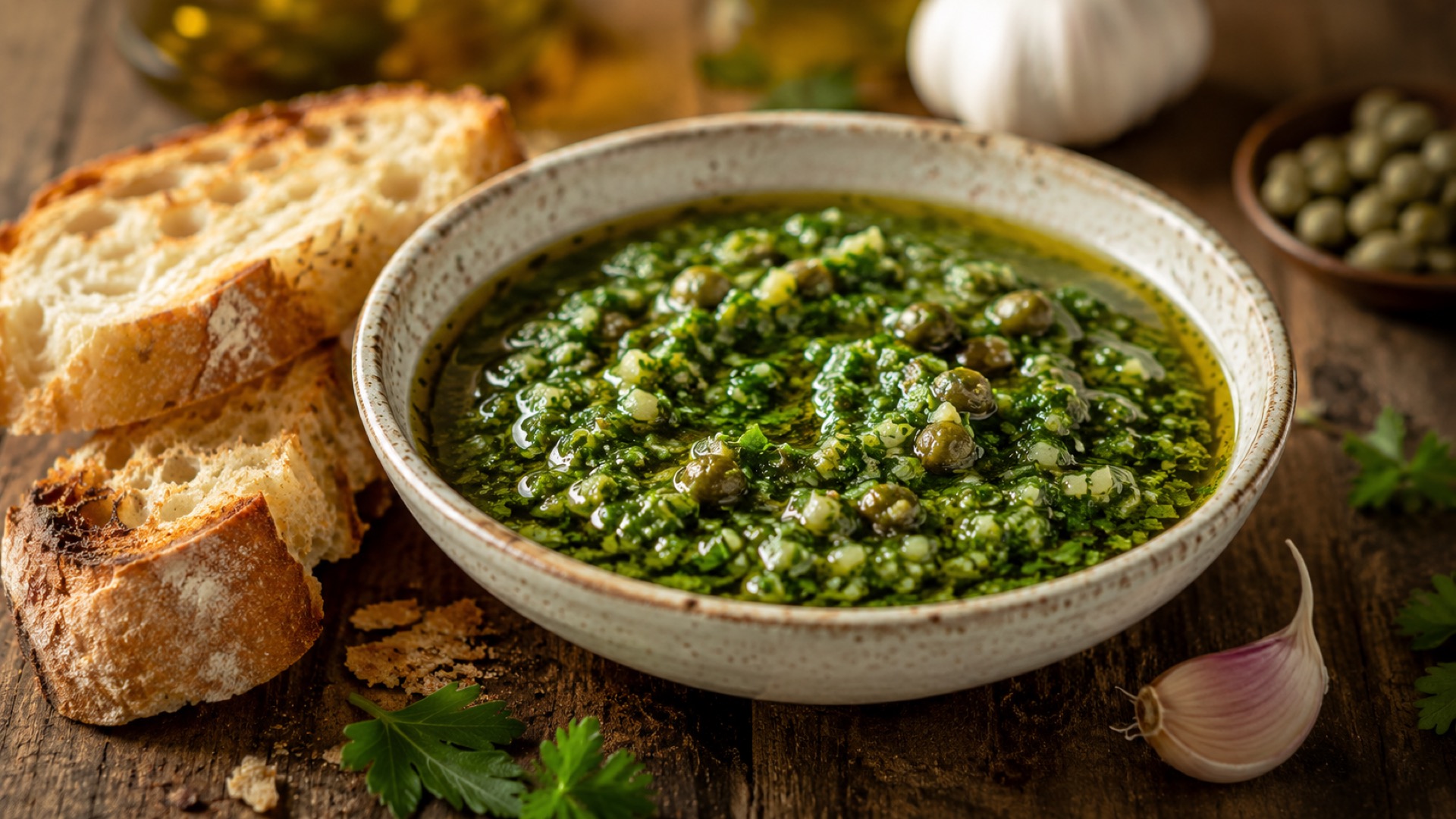
Italian salsa verde: not the Mexican one.
Parsley, capers, anchovies, garlic, olive oil, vinegar. Italy's sharpest condiment — for bollito misto, grilled fish, boiled meats, and anything that needs an argument on the plate.
METHOD
5 steps, and one will define the dish.
Stir well. Taste — sharp and herby.
Flavours settle. Adjust vinegar or salt.
Cold dulls the flavour.
WHY IT WORKS — THE SCIENCE
Knife, not blender.
Italian salsa verde is not Mexican salsa verde, which is made from tomatillos and bears no resemblance to it. Italian salsa verde is a herb condiment — dark green, sharp, intensely savoury — made from parsley, capers, anchovies, garlic, olive oil, and vinegar. It tastes like the opposite of mild.
It is the traditional accompaniment to bollito misto, the great northern Italian dish of mixed boiled meats — one of the richest, most fatty, most satisfying things in the Italian repertoire. Salsa verde exists to cut through that fat. Every element has a purpose: the parsley provides freshness, the capers provide brine, the anchovies provide depth, the vinegar provides acidity. Remove any of them and the sauce becomes less itself.
The knife, not the blender
Salsa verde must be made by hand. The chop of a knife creates an irregular texture — some pieces slightly larger, some almost paste — that a blender cannot replicate. A blender produces uniform purée, which feels different in the mouth and loses the textural contrast that makes the sauce interesting. This is one of those cases where the traditional method produces a superior result and the reason is not sentiment — it is texture.
“Salsa verde is the honest sauce. It hides nothing. If the parsley is old, you taste it. If the anchovies are poor quality, you taste it. If the olive oil is acidic, you taste it. There is nowhere to hide.”— GUALTIERO MARCHESI, CHEF