Boil water, butter, salt. Add flour all at once, stir until it leaves the sides. Off heat, beat in eggs one by one.
DESSERTS · NAPLES
Zeppole di San Giuseppe: the pastry that arrives once a year.
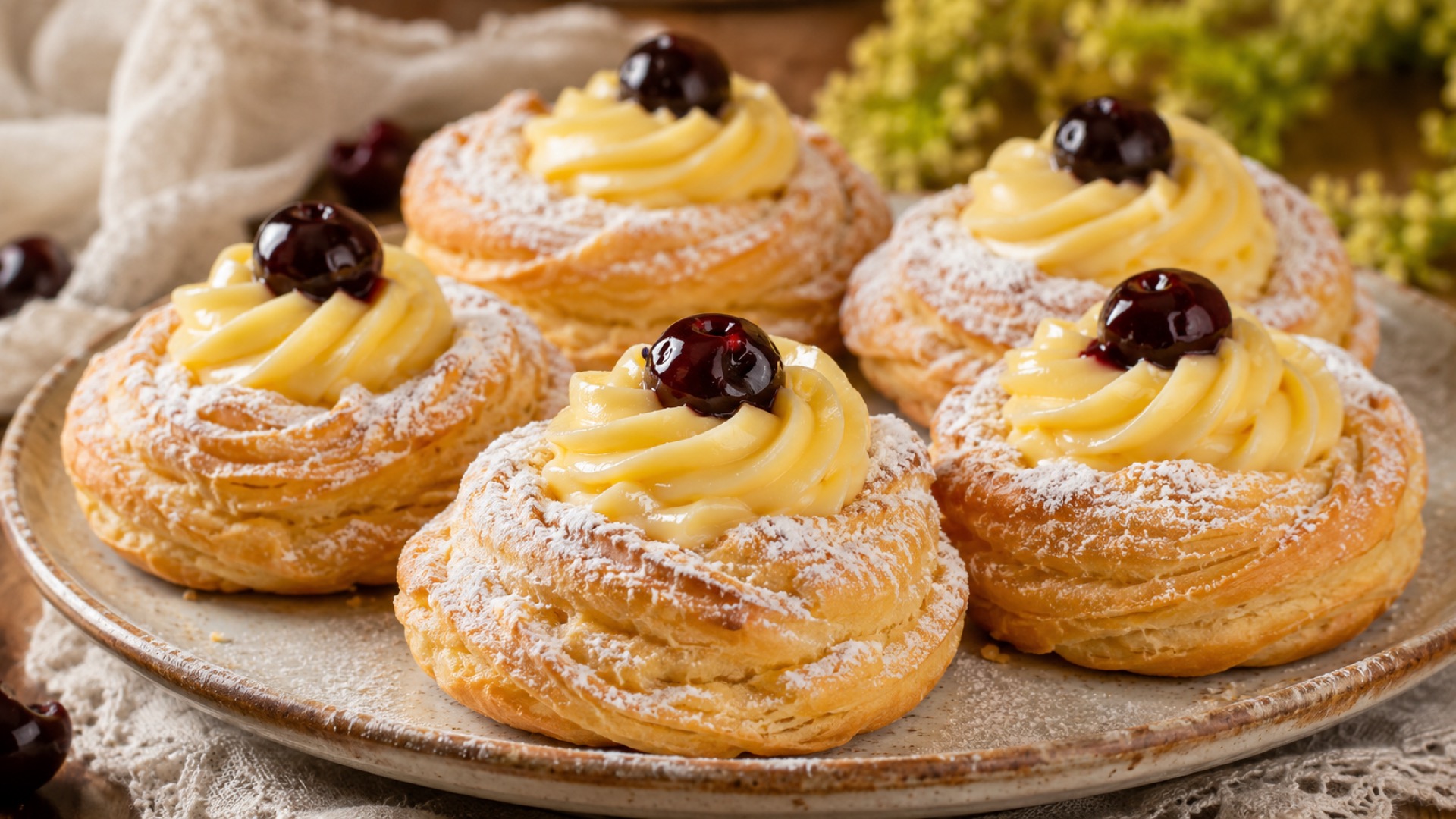
Made for the feast of Saint Joseph on 19 March, zeppole are choux pastry rings filled with pastry cream and topped with an amarena cherry. In Naples they are sold from every bar for exactly one week, then disappear until the following year.
METHOD
6 steps, and one will define the dish.
On a lined tray, pipe concentric rings 8cm diameter.
Do not open the oven. They must be golden and hollow.
Whisk yolks, sugar, cornstarch. Heat milk with vanilla. Combine, cook until thick. Cool completely.
Into and over the rings.
Two per zeppola. Dust with icing sugar.
WHY IT WORKS — THE SCIENCE
The choux must be piped in a double ring.
In Naples, the feast of Saint Joseph on 19 March is measured not in religious observance but in zeppole. For exactly one week around that date, every bar, bakery, and pastry shop in the city fills its windows with these choux rings, crowned with pastry cream and a single amarena cherry in dark syrup. Then the week ends and they disappear until the following year.
The zeppola di San Giuseppe can be baked or fried. The baked version is lighter and more common in the city today. The fried version — older, richer, slightly transgressive — is the one that Neapolitan nonnas still make at home and consider superior. Both are correct. The argument between the two camps has been going on for at least a hundred years and will not be resolved here.
The choux ring
The zeppola is piped in a double concentric ring — two rings of choux one on top of the other — which creates a stable hollow structure that can hold a significant amount of pastry cream. The centre of the ring is not filled; the cream sits in it like a crown. This is not decorative. It is structural engineering applied to pastry.
“We make zeppole for one week a year. The queue starts at 6am. By 9am we have sold 400. This tells you everything about Naples that you need to know.”— ATTILIO BACHETTI, PASTICCERIA BACHETTI, NAPLES