30 minutes in the fridge. Cold mortar prevents oxidation.
PASTA · LIGURIA
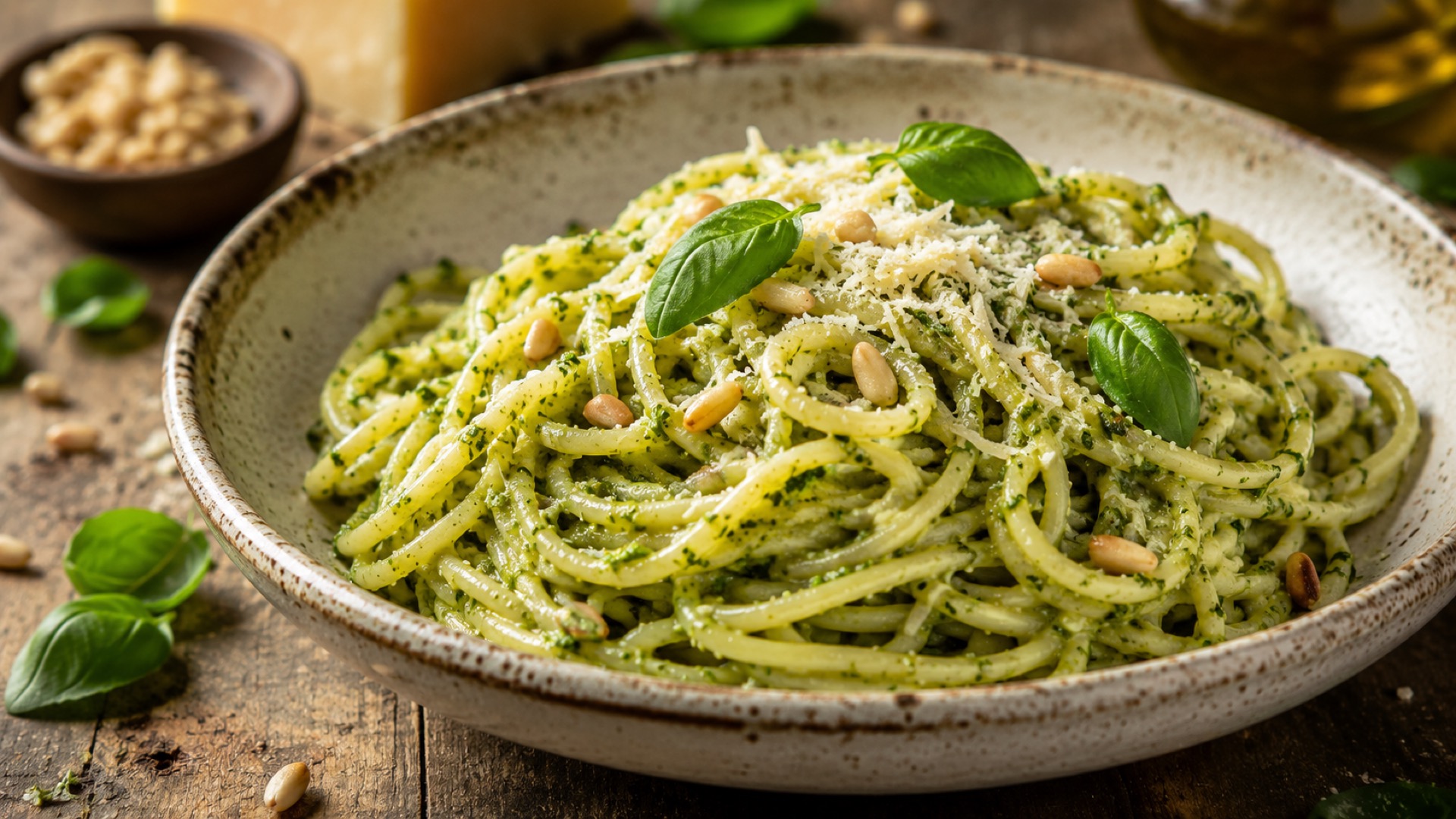
Pesto alla Genovese: the recipe, not the jar.
Seven ingredients in a marble mortar. The result is nothing like what comes out of a jar. The basil must be Genovese DOP, the technique must be cold, and the sauce must never touch a flame.
METHOD
7 steps, and one will define the dish.
Until a smooth paste.
Pound to a rough paste — not smooth.
Rotating motion, not pounding. Build gradually.
With a spoon, not the pestle.
Gradually, stirring. It should pour slowly.
A thin layer prevents browning.
WHY IT WORKS — THE SCIENCE
Cold tools, cold hands, rotating motion.
The pesto you have been eating most of your life is a reasonable approximation of pesto. The pesto made with a marble mortar, Genovese DOP basil, and Ligurian olive oil is something else — greener, fresher, more complex, and genuinely difficult to describe to someone who has not tried it. The two products share a name and a colour. The comparison mostly ends there.
The difference comes down to three things: the basil variety, the technique, and the temperature. Genovese DOP basil has smaller, more tender leaves with less chlorophyll and a more delicate perfume than the large-leaf varieties sold in supermarkets. The mortar technique prevents oxidation that blades cause. Cold tools extend the window before the basil turns.
Why the mortar matters
A food processor cuts the basil. A mortar pounds it. Cutting creates clean edges on the cell walls, which then oxidise rapidly on contact with air. Pounding tears the cells irregularly, releasing the aromatic oils more slowly and over a larger surface. The resulting pesto is greener, more stable, and more aromatic. A food processor produces pesto that begins to turn brown within the hour. A mortar produces pesto that holds its colour for several hours with an oil seal.
“The mortar is not tradition for its own sake. It produces a better product by a measurable margin. Anyone who makes pesto in a blender and insists they cannot tell the difference has not tasted both side by side.”— ROBERTO PANIZZA, WORLD PESTO CHAMPIONSHIP, GENOA
Pesto belongs to a small family of Italian sauces that never see a flame: salsa verde is its sharper northern cousin, and burro e salvia is what to make when even twenty minutes feels like too many.
SUBSTITUTIONS — IF YOU MUST
- GENOVESE DOP BASIL
- Outside Liguria, use the smallest, youngest basil you can find — large leaves bring a mint-and-clove note the original doesn't have. Buy living basil plants and rob them young.
- ITALIAN PINE NUTS
- Cheap imported pine nuts can leave a bitter metallic aftertaste for days ('pine mouth'). Walnuts are the honest budget fallback — Liguria itself uses them in salsa di noci.
- PECORINO SARDO
- Hard to source in the US. More Parmigiano plus a pinch of salt gets you close; Pecorino Romano is sharper, so halve the dose.
- MORTAR AND PESTLE
- A food processor is allowed at low pulse with a chilled blade — the sin is heat, not electricity.
STORAGE & REHEATING
- FRIDGE
- In a jar, surface sealed with a layer of oil: 4 days bright green, a week edible.
- FREEZER
- Ice-cube trays, then bagged: 3 months. Freeze it without the cheeses and fold them in after thawing.
- NEVER
- Heat it. Pesto is dressed onto hot pasta off the flame — the residual warmth is all the cooking it ever gets.
REAL QUESTIONS
Asked, answered.
Why did my pesto turn dark and bitter?
Heat and oxidation — blender blades at full speed cook the basil. Cold tools, low speed or a mortar, and seal the surface with oil immediately.
Can I make it in a food processor?
Yes: chill the bowl and blade, pulse briefly, never let it run. The mortar gives a rounder flavour because it crushes cells instead of slicing them — but a careful processor beats a tired arm.
What pasta goes with pesto?
Trofie or trenette, with green beans and potato boiled in the same pot. That combination is the actual Ligurian dish, not a variation.
How do I keep it green on the pasta?
Loosen the pesto with a spoonful of pasta water in the serving bowl, add the pasta, toss off the heat. Flame kills the colour first and the flavour second.
Can I use a different nut?
Walnuts, yes. Cashews and almonds appear in plenty of supermarket jars — and that's exactly why the jars taste like that.