You do not need to stir risotto constantly. Stop.
The instruction to stir risotto continuously appears in nearly every non-Italian recipe. In Milanese home kitchens, the risotto is stirred regularly — not constantly. There is a difference, and it matters for the texture.
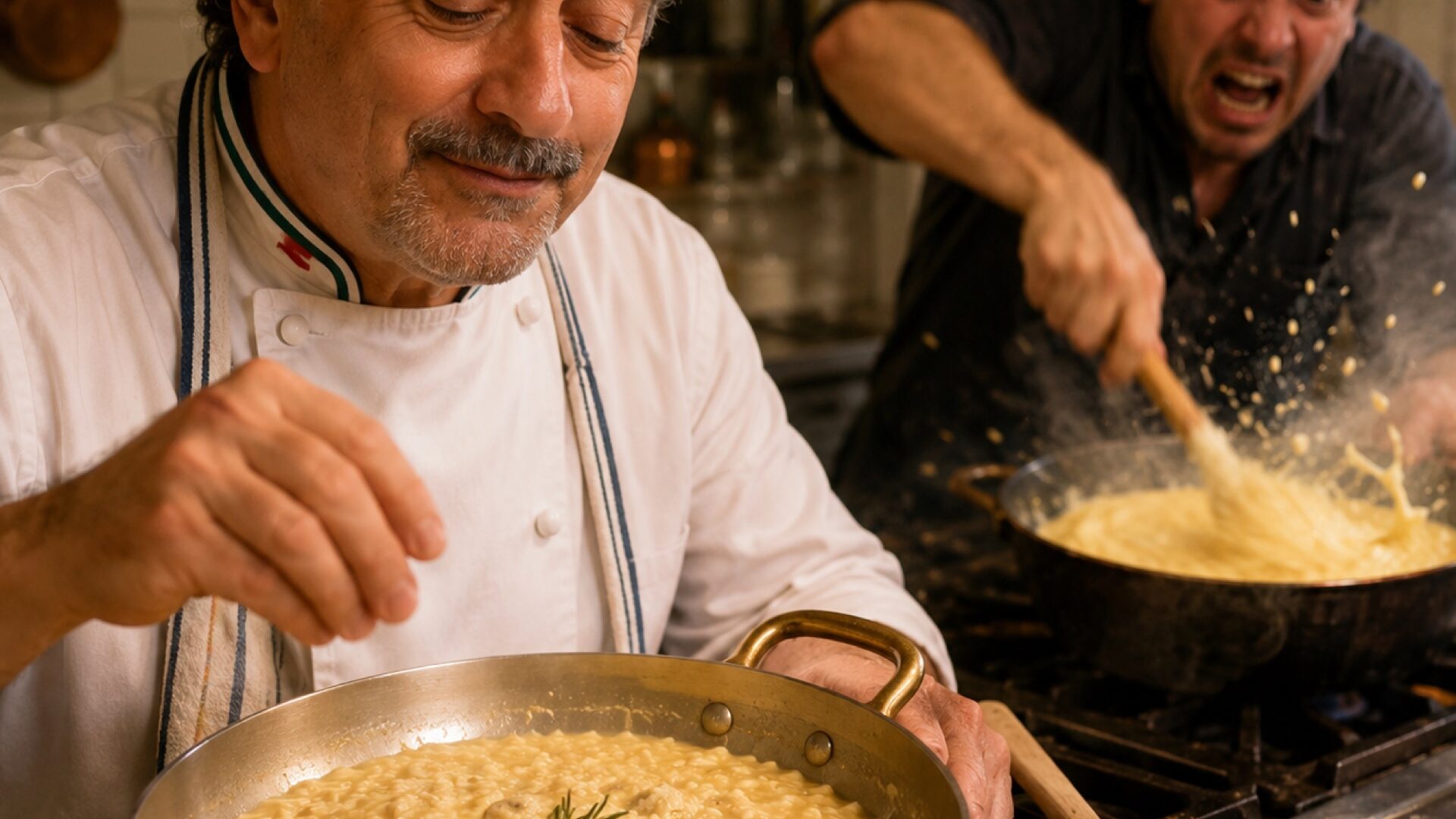
The instruction to stir risotto continuously — present in virtually every English-language recipe — is not how risotto is made in Lombardy, Piedmont, or anywhere else in northern Italy where risotto is a staple rather than a project. It is stirred regularly: a turn every 30 seconds or so, combined with a gentle shake of the pan. Continuous stirring produces a different texture, and not a better one.
The myth persists because it sounds right. Stirring releases starch; starch creates creaminess; therefore more stirring should mean more creaminess. The problem is that continuous stirring also breaks down the rice grains mechanically, producing a gluey, homogeneous paste rather than the loose, flowing texture — all’onda, “like a wave” — that Italian cooks consider correct.
All’onda: the correct consistency
The ideal risotto, when you tilt the plate, flows slowly to one side in a wave motion. It is neither a stiff mound nor a soup. The grains are distinct but bound together by a creamy coating of starch and fat. This consistency requires controlled starch release — achieved through regular, not constant, stirring — and a final mantecatura off the heat with cold butter beaten vigorously into the rice.
“I have been making risotto alla milanese since 1968. I stir it when it needs to be stirred. If I stirred it continuously, I would have paste. Paste is not risotto.”— AIMO MORONI, IL LUOGO DI AIMO E NADIA, MILAN
The mantecatura
The final step that most non-Italian recipes omit or understate is the mantecatura — the vigorous beating of cold butter into the risotto off the heat, just before serving. This creates the creamy emulsion that distinguishes a properly finished risotto from one that is merely cooked. The butter must be cold, the pan must be off the heat, and the motion must be energetic. Two minutes of this transforms the dish.