Most people who want to make fresh pasta at home buy a pasta machine, make tagliatelle twice, and then put the machine in a cupboard. The machine is fine. The problem is everything around it — the rolling pin is too short, the drying rack doesn’t exist, the scale measures in cups. Here are the eight tools that actually matter, in the order you will need them.
These are not the most expensive options on the market. They are the options that work correctly, last a long time, and will not make you feel like you need a professional kitchen to justify owning them.
01
Pasta Machine
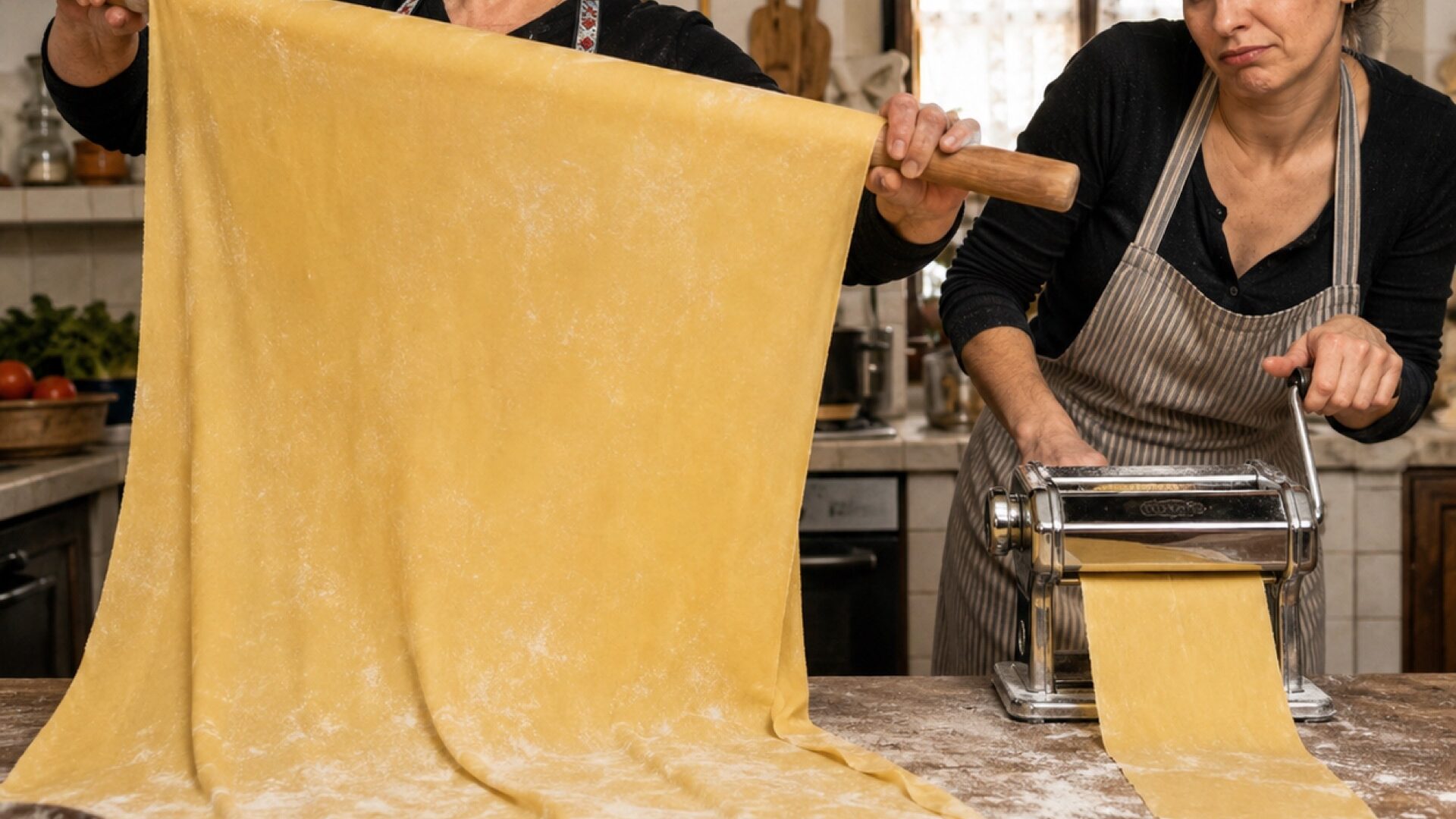
The Marcato Atlas 150 is the standard. It has been made in Italy since 1930, has seven thickness settings, and produces sheets from tagliatelle width down to lasagne. It clamps to the table, which means it stays where you put it. The chrome version is marginally more durable than the coloured editions. Get the plain chrome version and attach the motor later if you want it.
Check price on Amazon →
02
Italian Mattarello (Rolling Pin)
If you want to make pasta by hand — the way that produces a different, better texture than any machine — you need a mattarello. Not a standard rolling pin, which is too short and too thick. A proper Italian pasta rolling pin is at least 80cm long, untreated wood, completely smooth. The length is not aesthetic: you need to roll large sheets, and a short pin means constant repositioning.
Check price on Amazon →
03
Pasta Drying Rack
Fresh pasta needs to dry for 15–30 minutes before cooking or storing. You can drape it over a chair or a broom handle, which works fine and looks exactly like what it is. A wooden pasta drying rack costs almost nothing, folds flat for storage, and holds enough pasta for four people without the strands sticking together. It is one of those tools that is cheap enough that there is no reason not to own one.
Check price on Amazon →
04
Ravioli Mold
Making ravioli by hand, cutting them individually with a knife or wheel, produces ravioli of inconsistent size that open during cooking. A ravioli mold — a flat tray with a rolling pin that presses dough into dimpled squares — produces twelve uniform ravioli in the time it takes to cut three by hand. The mold costs very little, takes up no storage space, and makes filled pasta viable for a weeknight.
Check price on Amazon →
05
Gnocchi Board
A gnocchi board is a small ridged wooden paddle, about the size of your hand. You roll each gnocco across it to create the ridges that hold sauce. Without a gnocchi board, you use a fork, which works but takes longer and produces less consistent results. The board costs almost nothing, lasts forever, and is also used to shape cavatelli, garganelli, and several other pastas you will eventually want to make.
Check price on Amazon →
06
Digital Kitchen Scale
Fresh pasta is one of the most measurement-dependent preparations in Italian cooking. The ratio of flour to eggs determines the texture, the workability, and the final colour of the pasta. “Two eggs per 100g of flour” is the standard, and it only works if you actually weigh the flour. A scale that measures in 1-gram increments up to 5kg covers everything you will ever need to make. It is the most used tool in this list.
Check price on Amazon →
07
Pasta Cutter Wheel
A pasta wheel with a fluted edge cuts pasta sheets into pappardelle, maltagliati, and the zigzag edge of garganelli in a single pass. The straight edge cuts lasagne sheets and fresh tagliatelle. A double-sided wheel — one straight, one fluted — is more useful than two separate tools and costs the same amount as one. Look for a solid metal version with a wooden handle; the plastic ones break.
Check price on Amazon →
08
Flour Sifter
Tipo 00 flour for pasta does not strictly need sifting, but sifting removes any clumps that would create uneven hydration in the dough and produces a better-textured final pasta. More usefully, a sifter is the correct tool for dusting your pasta with semolina while it dries — it distributes the flour evenly without creating clumps. A simple drum sifter or rotary sifter is sufficient and costs next to nothing.
Check price on Amazon →
A note on what you do not need
You do not need an electric pasta extruder. You do not need a motorised pasta machine unless you are making pasta for six people every week. You do not need a pasta board — any large, clean wooden surface works. You do not need a chitarra unless you specifically want to make Abruzzese spaghetti alla chitarra, which is excellent and you should eventually make it, but it is not a starting point.
Start with the scale and the rolling pin. Everything else follows from there.