The mezzaluna: the knife your food processor will never replace.
A curved blade with two handles, rocked back and forth across a wooden board. No motor, no blades to wash, no noise. The mezzaluna has been in Italian kitchens for centuries. The food processor has been there since 1978 and has not improved anything.
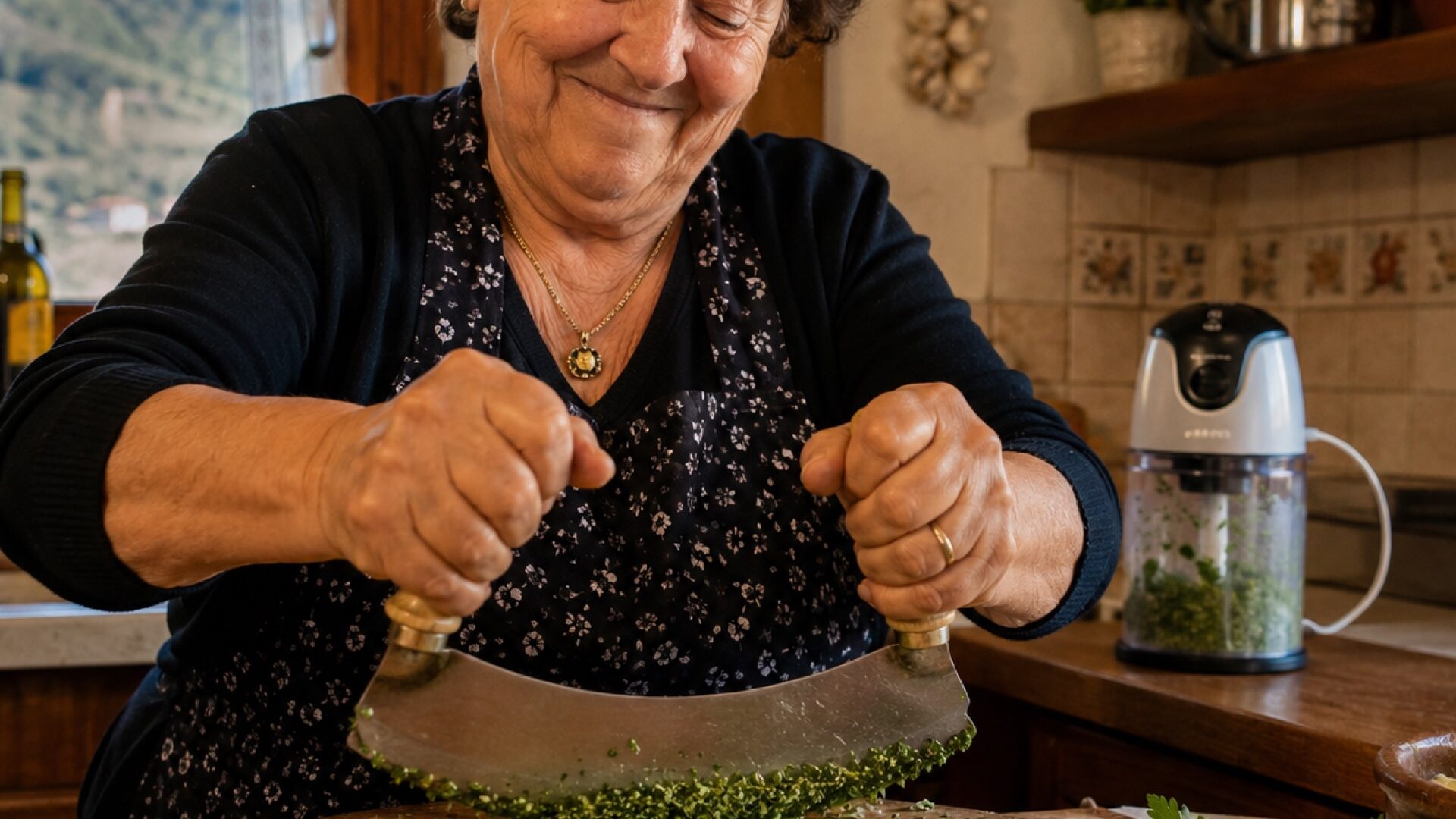
The mezzaluna — half moon — is a curved steel blade with a wooden handle at each end. You rock it back and forth across a wooden board with a rhythmic, meditative motion that requires no electricity, makes almost no noise, and produces a result that your food processor, despite its three speeds and eleven attachments, cannot replicate.
We understand that the food processor is faster. We understand it is easier to clean. We understand that in 2024 the idea of using a hand tool for something a machine can do in fifteen seconds feels eccentric. We are not asking you to be eccentric. We are asking you to use the right tool.
What the mezzaluna actually does
The food processor chops by impact — blades spinning at high speed that cut, bruise, and slightly puree whatever enters them. This produces a fine mince that releases moisture, loses its texture, and becomes a paste if you go five seconds too long. The mezzaluna chops by rocking — a clean, progressive cut that severs rather than crushes, leaving pieces that are uniform, dry, and distinct. For soffritto, for herb mixes, for anything that should be finely chopped but not liquefied, the difference is visible and tasteable.
“I have had a food processor for thirty years. I use it for breadcrumbs. For everything else, the mezzaluna. My soffritto has never been wet.”— LIDIA BASTIANICH, FELIDIA, NEW YORK
Maintenance: a word
A mezzaluna is a piece of steel. It needs to be sharp. A dull mezzaluna crushes instead of cuts and produces exactly the same result as the food processor you were trying to avoid. Have it sharpened once a year. This costs nothing. The board beneath it should be dedicated to the mezzaluna — the curved blade will eventually carve a shallow well into the wood, which actually helps the chopping motion. This is a feature, not damage.