Melt butter over low heat. Add flour all at once. Stir constantly 2 minutes — until biscuity, not raw.
SAUCE · ALL ITALY
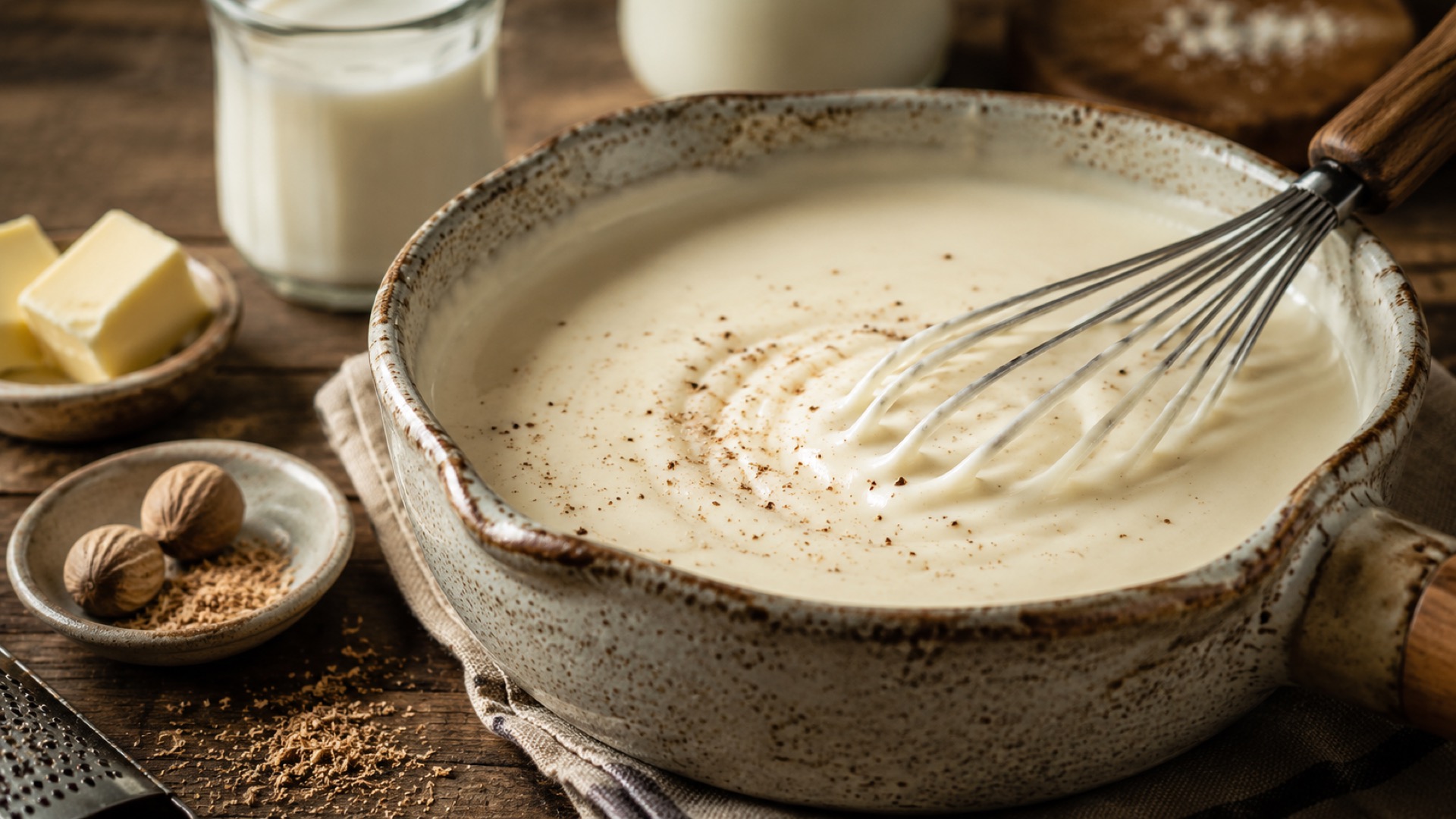
Besciamella: Italy’s white sauce, not France’s.
Butter, flour, milk, nutmeg, salt. The French call it béchamel. The Italians call it besciamella and say it was theirs first. The argument is unresolved. The recipe is the same.
METHOD
5 steps, and one will define the dish.
Small amount first, whisk until smooth. Repeat.
8–10 minutes over medium-low, whisking. Coats a spoon.
Salt, white pepper, generous nutmeg.
Cling film directly on the surface prevents a skin.
WHY IT WORKS — THE SCIENCE
The roux must cook before the milk goes in.
The French call it béchamel and credit it to Louis de Béchameil, a seventeenth-century French nobleman. The Italians call it besciamella and point to a recipe called salsa colla in a Florentine cookbook from 1891, which points to something older, which points to the general historical position that Catherine de’ Medici brought half of Italian cooking to France in the sixteenth century when she married Henry II. The argument has been going on for four hundred years and will not be resolved here.
What matters is that the sauce is essential to Italian cooking in a way it is not to French cooking. In France it is a mother sauce — a base for other preparations. In Italy it is a specific ingredient. It goes inside lasagne alla bolognese. It goes inside pasta al forno. It provides the creamy layer against which meat sauce and pasta create their alternating structure. Without it, these dishes do not hold together in the right way.
The roux: two minutes of cooking that matter
Equal weights of butter and flour cooked together before the milk is added — this is the roux. The cooking matters. A roux cooked for less than ninety seconds tastes of raw flour, and that taste survives the addition of milk and the final cooking. Two full minutes of stirring over low heat produce a roux that smells faintly of biscuit and provides no starchy aftertaste in the finished sauce.
“Besciamella is the simplest sauce to make badly and the most common reason a lasagne fails. Everything else in the dish can be correct and a bad besciamella will ruin it.”— PELLEGRINO ARTUSI, LA SCIENZA IN CUCINA, 1891
Consistency for lasagne versus other uses
For lasagne, make the besciamella looser than seems right at the time of assembly. During baking, the sauce absorbs moisture from the pasta sheets and the meat sauce, and thickens considerably. A besciamella that is perfect at room temperature produces dry, stiff layers after 40 minutes at 180°C. Make it pourable — closer to a thick cream than to a paste — and trust the oven to finish the job.
Besciamella is one of the quiet foundations of the Italian kitchen — the other is a proper tomato sauce. Master both and most of Emilia-Romagna’s baked pasta repertoire is suddenly within reach. For the sauce that takes even less time, there’s burro e salvia.
SUBSTITUTIONS — IF YOU MUST
- TYPE 00 FLOUR
- All-purpose flour behaves identically in a roux. The 00 grind matters for pasta and pizza, not here.
- FULL FAT MILK
- Whole milk, non-negotiable. 2% makes a thinner, sadder sauce that no amount of extra roux fully fixes.
- NUTMEG
- Buy whole nutmeg and a microplane — pre-ground nutmeg is mostly a memory of nutmeg. In Italian besciamella it's a signature, not a garnish.
STORAGE & REHEATING
- FRIDGE
- 3 days, with cling film pressed directly onto the surface — skin is the enemy.
- FREEZER
- Technically yes, but it splits and needs vigorous re-whisking over low heat. Fresh takes 15 minutes; do the math.
- REHEAT
- Low heat, whisking constantly, loosened with a splash of warm milk back to pouring consistency.
REAL QUESTIONS
Asked, answered.
My besciamella has lumps. Can it be saved?
Yes — whisk hard off the heat, or pass it through a sieve and tell no one. Next time: warm milk, added gradually, whisking from the first drop.
It tastes like raw flour.
The roux didn't cook long enough before the milk went in. Two full minutes, until it smells faintly of biscuit — that step cannot be rushed.
What consistency for lasagna?
Looser than feels right. It thickens further in the oven; besciamella that's perfect in the pot is cement between pasta sheets.
Béchamel or besciamella — who invented it?
Both countries claim it; the Tuscans were making 'salsa colla' before the French named theirs. The argument is unresolved and the roux doesn't care.
Can I make it with olive oil instead of butter?
You can — parts of the south do. It's looser and tastes of oil. For lasagne alla bolognese, butter is the right answer.